

Negociação
Explore uma ampla variedade de mercados com preços competitivos, alta liquidez e ferramentas de negociação avançadas.
Saiba Mais 
Plataforma
Negocie sem interrupções com a poderosa plataforma da TMGM, desenvolvida para velocidade, precisão e uma experiência de negociação superior.
Saiba Mais Plataforma de Negociação
Ferramentas de Negociação
Academia
Aprenda os fundamentos da negociação com recursos para iniciantes, incluindo guias, webinars e insights de mercado.
Saiba Mais TMGM Academy
Notícias & Análise
Receba atualizações de mercado em tempo real e análises de especialistas para se antecipar às oportunidades de negociação.
Saiba Mais Notícias & Análise
Sobre
Descubra o que diferencia a TMGM — nossa presença global, força regulatória e compromisso com a inovação em negociação.
Saiba Mais Por Que Escolher a TMGM
The Euro breaks to a fresh low, then bounces, as Spain calls a snap vote
- EUR/USD breaks to its lowest since May 2025 as Spain heads for a snap election.
- Euro area producer prices up 8.2% YoY in August, from 5.8% in July.
- ECB account of the September 10 hike due Thursday at 11:30 GMT.
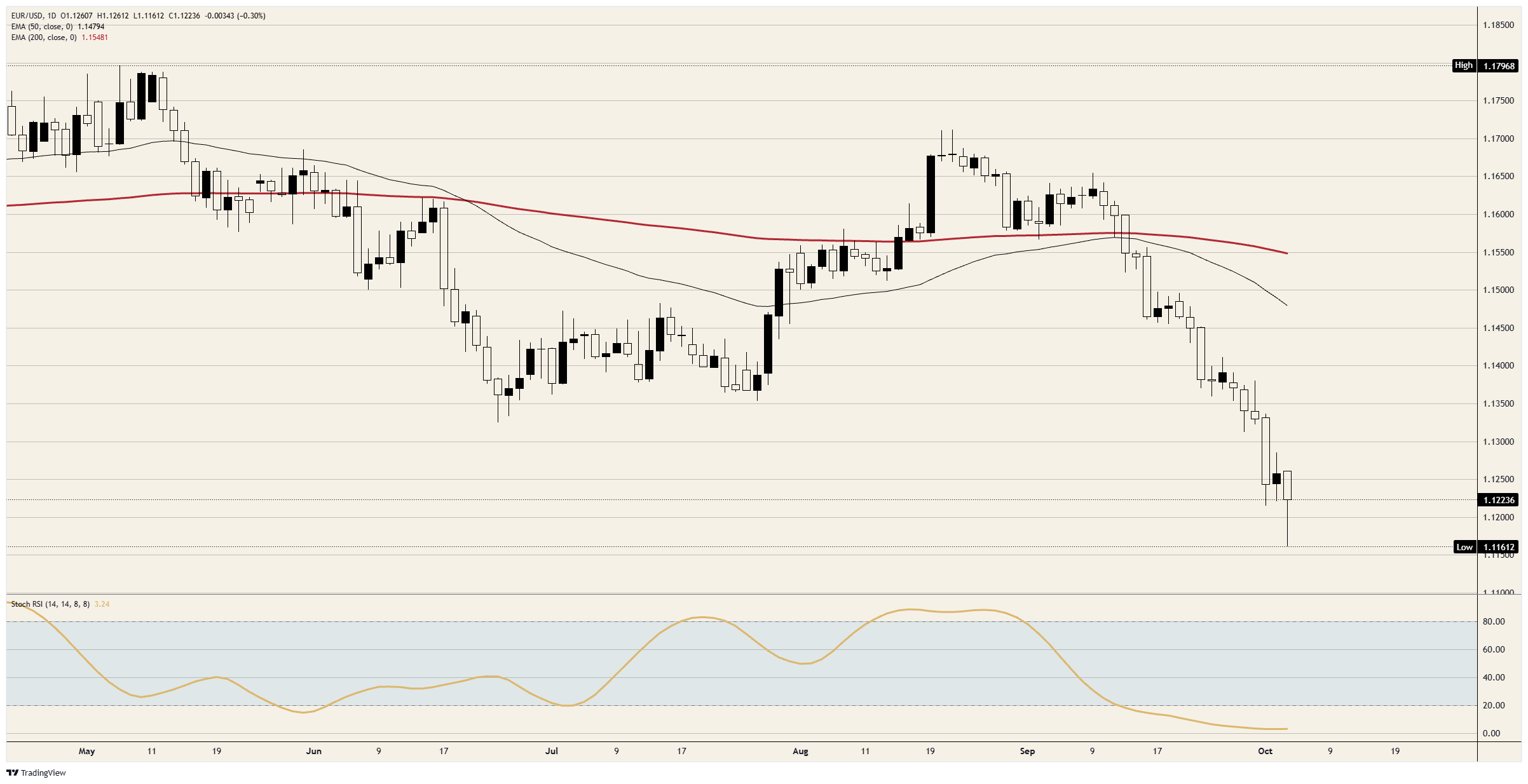
Reports that Spain's government was preparing an early election pushed EUR/USD to its lowest since May 2025, and hedge-fund selling in Asia set off option barriers that deepened the fall, traders said. The pair has since recovered more than half of that drop and trades back above 1.1200. Prime Minister Sánchez's confirmation of a November 29 vote on Monday, after parliament rejected his housing plan on Friday, did less damage than the reports that came before it.

Inflation 1.3 points over the ECB's rate, and a case for fewer hikes
European Central Bank (ECB) Chief Economist Lane said on Monday that costlier energy and higher long-term borrowing costs are already slowing demand, which could limit how far the ECB has to raise rates. Bundesbank President Nagel said separately that there are no clear signs yet of inflation feeding into wages and price-setting. Euro area inflation reached 3.8% in September, its highest since September 2023.
The ECB's deposit rate is 2.50% after increases in June and September, and money markets price two to three more over the coming year. Fewer would strip rate support from EUR/USD, and Spain and France are adding political risk at the same time. Chief Economist Lane made his case on the same day euro area producer prices were reported 8.2% higher than a year earlier.
Thursday's ECB account covers September, not the three weeks since
Euro area retail sales for August are out on Tuesday at 09:00 GMT, forecast to rise 0.2% MoM after a 0.6% fall in July. The forecast rise would win back a third of the fall. ECB Executive Board members Cipollone and Elderson both speak at 13:00 GMT, and a miss would add weight to Chief Economist Lane's argument for fewer hikes.
The ECB publishes the account of its September 10 meeting on Thursday at 11:30 GMT, after Chief Economist Lane speaks again at 10:00 GMT. That meeting came three weeks before the gap between French and German 10-year yields posted its biggest weekly rise in 17 years. Minutes of the Fed's September meeting are out on Wednesday at 18:00 GMT, and any lean toward more US hikes would push EUR/USD lower from the Dollar side.
Levels after the Euro's new low
Resistance: Monday's high is its opening level, just above 1.1250, so the pair hasn't traded above where it started the session. Friday's high, just short of 1.1300, comes next.
Support: Monday's low, just above 1.1150, is the lowest since May 2025. 1.1100 comes next, just above the May 2025 low.
Bias: Risk-reward stays skewed lower below 1.1300, with 1.1150 the first objective and 1.1100 after it. The daily Stochastic Relative Strength Index (Stoch RSI) is near 3 and has been under 20 since mid-September, so a bounce toward 1.1250 can run without changing the call. A daily close above 1.1350 would end it.
EUR/USD daily chart
Euro FAQs
The Euro is the currency for the 20 European Union countries that belong to the Eurozone. It is the second most heavily traded currency in the world behind the US Dollar. In 2022, it accounted for 31% of all foreign exchange transactions, with an average daily turnover of over $2.2 trillion a day. EUR/USD is the most heavily traded currency pair in the world, accounting for an estimated 30% off all transactions, followed by EUR/JPY (4%), EUR/GBP (3%) and EUR/AUD (2%).
The European Central Bank (ECB) in Frankfurt, Germany, is the reserve bank for the Eurozone. The ECB sets interest rates and manages monetary policy. The ECB’s primary mandate is to maintain price stability, which means either controlling inflation or stimulating growth. Its primary tool is the raising or lowering of interest rates. Relatively high interest rates – or the expectation of higher rates – will usually benefit the Euro and vice versa. The ECB Governing Council makes monetary policy decisions at meetings held eight times a year. Decisions are made by heads of the Eurozone national banks and six permanent members, including the President of the ECB, Christine Lagarde.
Eurozone inflation data, measured by the Harmonized Index of Consumer Prices (HICP), is an important econometric for the Euro. If inflation rises more than expected, especially if above the ECB’s 2% target, it obliges the ECB to raise interest rates to bring it back under control. Relatively high interest rates compared to its counterparts will usually benefit the Euro, as it makes the region more attractive as a place for global investors to park their money.
Data releases gauge the health of the economy and can impact on the Euro. Indicators such as GDP, Manufacturing and Services PMIs, employment, and consumer sentiment surveys can all influence the direction of the single currency. A strong economy is good for the Euro. Not only does it attract more foreign investment but it may encourage the ECB to put up interest rates, which will directly strengthen the Euro. Otherwise, if economic data is weak, the Euro is likely to fall. Economic data for the four largest economies in the euro area (Germany, France, Italy and Spain) are especially significant, as they account for 75% of the Eurozone’s economy.
Another significant data release for the Euro is the Trade Balance. This indicator measures the difference between what a country earns from its exports and what it spends on imports over a given period. If a country produces highly sought after exports then its currency will gain in value purely from the extra demand created from foreign buyers seeking to purchase these goods. Therefore, a positive net Trade Balance strengthens a currency and vice versa for a negative balance.
ARTIGOS POPULARES
1Gold holds steady below $4,150 amid elevated US yields 2Australian Dollar defies rising yields as AUD/USD closes in on 0.703The New Zealand Dollar holds near its lows while business confidence jumps4US Treasury yields scale multi-year highs as inflation fears return5Ethereum Price Forecast: BitMine scoops extra ETH tokens following Q3 outperformance6The Euro breaks to a fresh low, then bounces, as Spain calls a snap vote7The Pound flatlines as Treasury yields climb to another high8Mexican Peso builds winning streak as USD/MXN drifts toward 18.009Corporate Bitcoin buying accelerates as Strategy, Strive and Metaplanet expand BTC treasuries
COTAÇÕES AO VIVO


Comece Agora!
Cadastre-se e acesse os Mercados Globais em menos de 3 minutos

Conecte-se Conosco









Contatos
Telefone: +61 2 8036 8388
Fax: +61 2 8036 8388
Email: support@tmgm.com
Web: https://www.tmgm.com



As informações fornecidas neste website são apenas de natureza geral e não constituem aconselhamento financeiro pessoal. Antes de agir com base em qualquer informação neste website, deve considerar a adequação da informação em relação aos seus objetivos, situação financeira e necessidades. Investir em CFDs e contratos de margem de FX envolve riscos significativos e não é adequado para todos os investidores. Poderá perder mais do que o seu depósito inicial. Não possui, nem detém, qualquer interesse no ativo subjacente. Recomendamos que procure aconselhamento independente e que se certifique de que compreende plenamente os riscos envolvidos antes de negociar. É importante que leia e considere o documento de divulgação antes de adquirir qualquer produto listado no website. As informações e os anúncios oferecidos neste website não se destinam a ser utilizados por qualquer pessoa em qualquer país ou jurisdição onde tal utilização seja contrária às leis e regulamentos locais. Os Produtos e Serviços oferecidos neste website não se destinam a residentes dos Estados Unidos, da Malásia e da Tailândia.
A TMGM é autorizada e regulada em várias jurisdições.
Trademax Australia Limited, operando como TMGM, é regulada pela Comissão Australiana de Valores Mobiliários e Investimentos (ASIC), AFSL nº 436416 e está localizada no Level 28, One International Tower, 100 Barangaroo Avenue, 2000 Sydney, NSW Austrália.
Email: support@tmgm.com.au
Trademax Global Limited, operando como TMGM, é autorizada e regulada pela Comissão de Serviços Financeiros de Vanuatu (VFSC), número de registro 40356 e registrada em 1276, Kumul Highway, Port Vila, Vanuatu, República de Vanuatu.
Email: support@tmgm.com
Trademax Global Markets (SE) Limited, operando como TMGM, é autorizada e regulada pela Autoridade de Serviços Financeiros (FSA) das Seychelles, sob o número de licença SD224. A empresa está registrada no Escritório nº 13, Providence Estate ABIS Centre, Mahe, Seychelles.
Email: support@tmgm.com
Trademax Global Markets (International) Pty Ltd, operando como TMGM, é autorizada e regulada pela Comissão de Serviços Financeiros de Maurício (FSC) com licença nº GB22201012, e registrada em 33, Edith Cavell Street C/o IQ EQ Fund Services (Mauritius) Ltd Port Louis, 11324 Maurício.
Email: support@tmgm.com
Copyright © TMGM. Todos os direitos reservados