

Trading
Explora una amplia gama de mercados con precios competitivos, liquidez profunda y herramientas de trading avanzadas.
Más información 
Plataforma
Opera sin interrupciones con la potente plataforma de TMGM, diseñada para ofrecer velocidad, precisión y una experiencia de trading superior.
Más información Plataforma de trading
Herramientas de trading
Academia
Aprende los fundamentos del trading con recursos ideales para principiantes, incluidas guías, seminarios web y análisis del mercado.
Más información Academia TMGM
Noticias y análisis
Obtén actualizaciones del mercado en tiempo real y análisis de expertos para adelantarte a las oportunidades de trading
Más información Noticias y análisis
Acerca de
Descubre qué distingue a TMGM: nuestra presencia global, solidez regulatoria y compromiso con la innovación en el trading.
Más información Por qué elegir TMGM
US Treasury yields scale multi-year highs as inflation fears return
- US10-year yield climbs above 5.30% as bond selling intensifies.
- ISM prices paid jumps to 74.0 despite slower services growth.
- October Fed hold odds rise to 76% after weak payrolls.
US Treasury yields edged up at the beginning of the week, with the 30- and 10-year yields reaching multi-year highs as inflation expectations rose, as shown in a US Institute for Supply Management (ISM) survey indicating that business activity in the services sector slowed while input prices surged.
Rising input prices and France’s fiscal woes push global borrowing costs higher

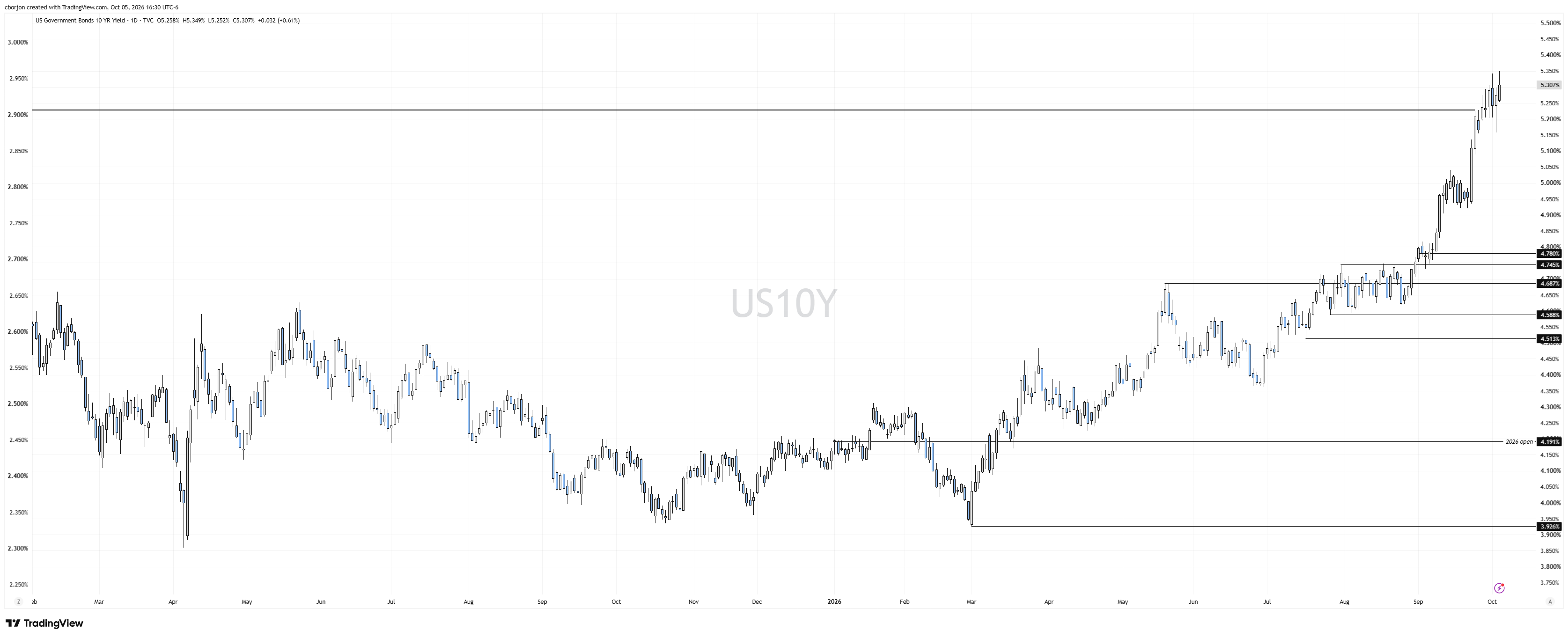
The US 10-year Treasury note yield gains more than 3 basis points to 5.307%, amid growing fears that high energy prices may drive global bond yields higher.
The ISM Services PMI fell below estimates of 55, edging down from 55.4 to 54.9, while new orders and employment sub-components improved, but prices paid indicate that companies are reporting higher costs.
In addition, France’s fiscal crisis sent global bond yields higher amid investors' worries about next year’s budget.
Aside from this, in the commodity complex, West Texas Intermediate (WTI), the US Oil benchmark, fell more than 2% at $89.29 on Monday, due to the G7 agreeing to freeing over 100 million barrels of crude and diesel. This boosted supplies and eased pressure from the US as President Trump threatened to impose a ban on diesel exports.
Last Friday, US yields cooled following a weaker jobs report, which showed job creation of 29K, missing forecasts of 90K.
Ahead, traders eye the release of the ADP Employment Change 4-week average figures on Tuesday, followed by the unveiling of the FOMC monetary policy meeting minutes on Wednesday.
Chances of a Federal Reserve interest rate hike this month were diminished by recent cooler-than-expected inflation data. Money markets were last pricing in roughly a 76% probability that rates would remain unchanged at the Fed's October 27-28 meeting, according to Prime Terminal.
US 10-year daily chart
Interest rates FAQs
Interest rates are charged by financial institutions on loans to borrowers and are paid as interest to savers and depositors. They are influenced by base lending rates, which are set by central banks in response to changes in the economy. Central banks normally have a mandate to ensure price stability, which in most cases means targeting a core inflation rate of around 2%. If inflation falls below target the central bank may cut base lending rates, with a view to stimulating lending and boosting the economy. If inflation rises substantially above 2% it normally results in the central bank raising base lending rates in an attempt to lower inflation.
Higher interest rates generally help strengthen a country’s currency as they make it a more attractive place for global investors to park their money.
Higher interest rates overall weigh on the price of Gold because they increase the opportunity cost of holding Gold instead of investing in an interest-bearing asset or placing cash in the bank. If interest rates are high that usually pushes up the price of the US Dollar (USD), and since Gold is priced in Dollars, this has the effect of lowering the price of Gold.
The Fed funds rate is the overnight rate at which US banks lend to each other. It is the oft-quoted headline rate set by the Federal Reserve at its FOMC meetings. It is set as a range, for example 4.75%-5.00%, though the upper limit (in that case 5.00%) is the quoted figure. Market expectations for future Fed funds rate are tracked by the CME FedWatch tool, which shapes how many financial markets behave in anticipation of future Federal Reserve monetary policy decisions.
Artículos destacados
1The Japanese Yen firms on a BoJ speech about AI and gives it all back2Gold holds steady below $4,150 amid elevated US yields 3Australian Dollar defies rising yields as AUD/USD closes in on 0.704The New Zealand Dollar holds near its lows while business confidence jumps5US Treasury yields scale multi-year highs as inflation fears return6Ethereum Price Forecast: BitMine scoops extra ETH tokens following Q3 outperformance7The Euro breaks to a fresh low, then bounces, as Spain calls a snap vote8The Pound flatlines as Treasury yields climb to another high9Mexican Peso builds winning streak as USD/MXN drifts toward 18.00
COTIZACIONES EN VIVO


¡Comience ahora!
Regístrese y acceda a los mercados globales en menos de 3 minutos

Conéctese con nosotros









Contactos
Teléfono: +61 2 8036 8388
Fax: +61 2 8036 8388
Correo electrónico: support@tmgm.com
Web: https://www.tmgm.com



La información proporcionada en este sitio web es únicamente de carácter general y no constituye asesoramiento financiero personal. Antes de actuar sobre cualquier información de este sitio web, debe considerar la idoneidad de la información en relación con sus objetivos, situación financiera y necesidades. Invertir en CFD y contratos de margen de FX conlleva riesgos significativos y no es adecuado para todos los inversores. Puede perder más que su depósito inicial. Usted no posee ni tiene ningún interés en el activo subyacente. Le recomendamos que busque asesoramiento independiente y se asegure de comprender plenamente los riesgos involucrados antes de operar. Es importante que lea y considere el documento de divulgación antes de adquirir cualquier producto listado en el sitio web. La información y los anuncios ofrecidos en este sitio web no están destinados al uso por parte de ninguna persona en ningún país o jurisdicción donde dicho uso sea contrario a las leyes y regulaciones locales. Los productos y servicios ofrecidos en este sitio web no están destinados a residentes de Estados Unidos, Malasia y Tailandia.
TMGM está autorizado y regulado en varias jurisdicciones.
Trademax Australia Limited, que opera como TMGM, está regulada por la Comisión Australiana de Valores e Inversiones (ASIC), AFSL n.º 436416, y está ubicada en Level 28, One International Tower, 100 Barangaroo Avenue, 2000 Sydney, NSW Australia.
Correo electrónico: support@tmgm.com.au
Trademax Global Limited, que opera como TMGM, está autorizada y regulada por la Comisión de Servicios Financieros de Vanuatu (VFSC), número de registro 40356, y está registrada en 1276, Kumul Highway, Port Vila, Vanuatu, República de Vanuatu.
Correo electrónico: support@tmgm.com
Trademax Global Markets (SE) Limited, que opera como TMGM, está autorizada y regulada por la Autoridad de Servicios Financieros (FSA) de Seychelles, con número de licencia SD224. La empresa está registrada en Office No 13, Providence Estate ABIS Centre, Mahe, Seychelles.
Correo electrónico: support@tmgm.com
Trademax Global Markets (International) Pty Ltd, que opera como TMGM, está autorizada y regulada por la Comisión de Servicios Financieros de Mauricio (FSC) con licencia n.º GB22201012, y está registrada en 33, Edith Cavell Street C/o IQ EQ Fund Services (Mauritius) Ltd Port Louis, 11324 Mauricio.
Correo electrónico: support@tmgm.com
Copyright © TMGM. Todos los derechos reservados