

Trading
Explora una amplia gama de mercados con precios competitivos, liquidez profunda y herramientas de trading avanzadas.
Más información 
Plataforma
Opera sin interrupciones con la potente plataforma de TMGM, diseñada para ofrecer velocidad, precisión y una experiencia de trading superior.
Más información Plataforma de trading
Herramientas de trading
Academia
Aprende los fundamentos del trading con recursos ideales para principiantes, incluidas guías, seminarios web y análisis del mercado.
Más información Academia TMGM
Noticias y análisis
Obtén actualizaciones del mercado en tiempo real y análisis de expertos para adelantarte a las oportunidades de trading
Más información Noticias y análisis
Acerca de
Descubre qué distingue a TMGM: nuestra presencia global, solidez regulatoria y compromiso con la innovación en el trading.
Más información Por qué elegir TMGM
Gold springs from $4,110 as Oil rout eases inflation heat
- Gold rebounds over 1% as WTI tumbles below $90.
- Fed's Williams tempers rate-hike urgency while other officials remain hawkish.
- ADP, Core PCE and NFP now steer bullion’s next move.
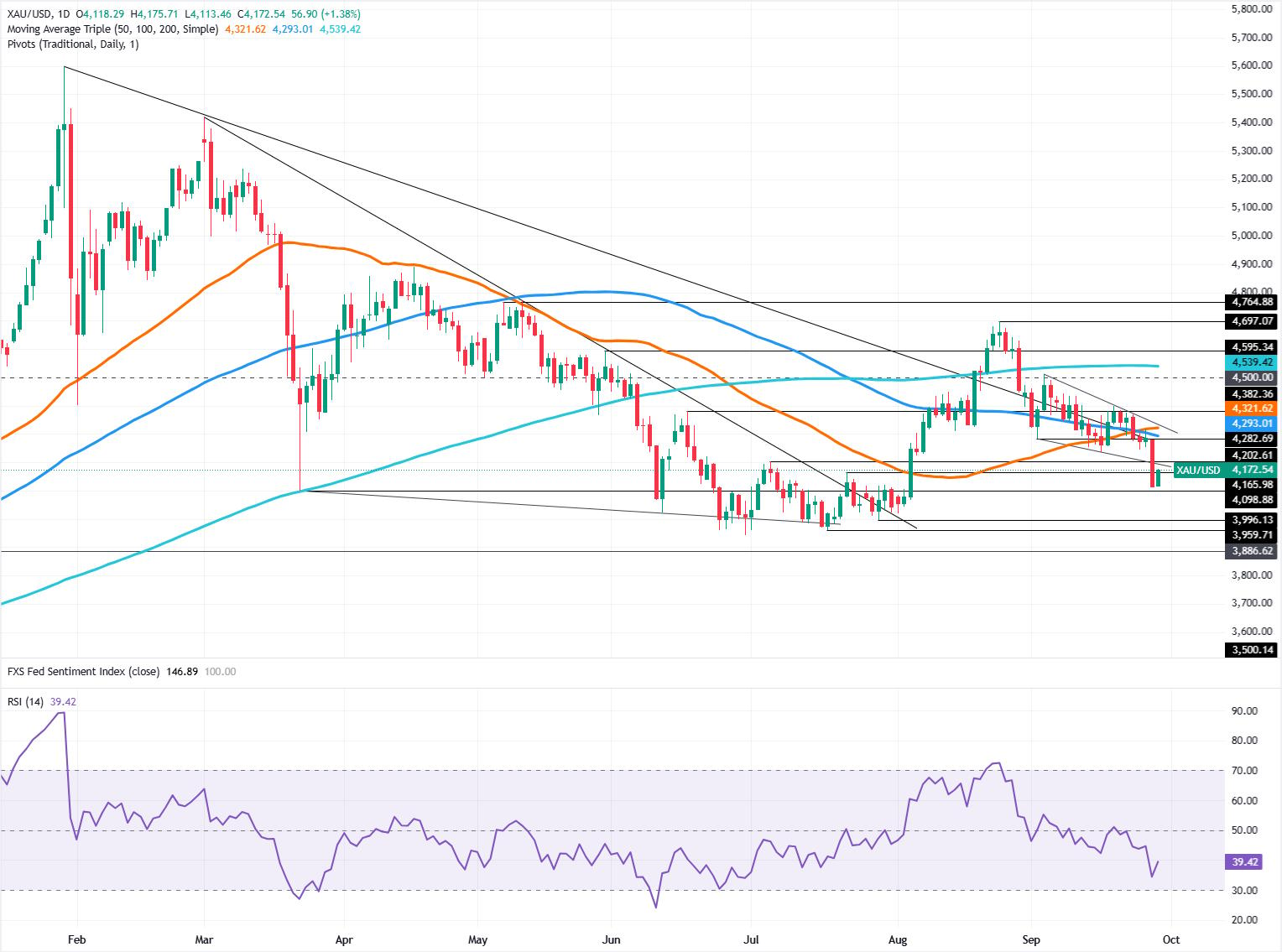
Gold (XAU/USD) price registers solid gains of over 1.30% on Tuesday despite hawkish rhetoric from Federal Reserve (Fed) officials, after hitting a multi-week low near $4,110 on Monday. The XAU/USD pair trades at $4,170 after bouncing off daily lows of $4,113.
XAU/USD rebounds sharply as collapsing crude offsets stubborn Dollar and yield strength

Bullion’s recovery is mainly attributed to lower energy prices. West Texas Intermediate (WTI), the US crude benchmark, collapses during the trading session, down 4.27% to $89.10 per barrel. Although this eased inflationary pressures, US Treasury yields and the Greenback remain higher, as New York Fed President John Williams said they’re in no rush to raise rates.
Williams added that price stability is “foundational for the economy,” and that inflation should ease as shocks have “largely played out.”
The US 10-year Treasury yield is up two basis points at 5.255%, near 2004 levels. The US Dollar Index (DXY), which tracks the buck’s performance against six currencies) gains 0.20% at 101.37.
Usually, a higher Dollar makes bullion more expensive for foreign buyers, but the drop in energy prices underpinned the yellow metal.
Aside from Williams dovish tilt, others like St. Louis Fed Alberto Musalem, Chicago’s Fed Austan Goolsbee and Fed Governor Michael Barr, remained in the hawkish camp.
Musalem said that policy is “still accommodative,” while Goolsbee said that “persistent inflation is like playing with fire.” Meanwhile, Governor Barr was more direct, stressing that policy needs “recalibration” and further rate increases.
Data-wise, the Conference Board reported that consumer confidence deteriorated in September, with the poll showing Americans' anxiety about the high cost of living amid rising gasoline prices. Dana Peterson, the chief economist of the Conference Board, wrote, “References to prices, the high cost of goods and services, and oil and gas prices in particular, rose to new heights.”
The Job Openings and Labor Turnover Survey (JOLTS) in August reported a decline from 7.335 million to 7.079 million, indicating that job openings declined while layoffs remained low, reaffirming the low-hiring, low-firing scenario.
Other data showed that job openings fell in August, though layoffs remained low, reaffirming that the US labor market could withstand further tightening by the Federal Reserve.
Money markets currently see a 68% probability of a Fed rate hike in October and a 95% chance of an increase in December, according to the Prime Terminal data.
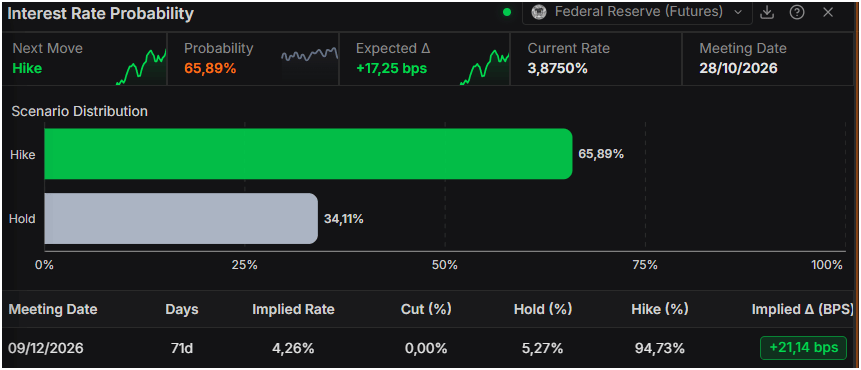
Traders' eyes shift to Wednesday’s data, focused on the ADP National Employment Change, the Federal Reserve’s favorite inflation gauge, the Core Personal Consumption Expenditures (PCE) Price Index, Gross Domestic Product (GDP) figures for Q3 on its first reading and September’s Nonfarm Payrolls print.
XAU/USD technical analysis: Gold climbs, but faces strong resistance near $4,200
After bottoming near $4,100, XAU/USD is aiming higher but is about to test the bottom trendline of the ‘bullish wedge’, which, if cleared, could open the door to reclaim $4,200.
Nevertheless, momentum remains tilted to the downside, as indicated by the Relative Strength Index (RSI), which remains below its 50-neutral level. With that said, Gold’s path of least resistance is tilted to the downside.
Therefore, bullion’s first support is the September 28 swing low of $4,110. Below is $4,100, followed by the psychological $4,000 mark. The next support area sits at $3,996, the July 29 low of the day (LOD), followed by the yearly low of $3,941.
Gold FAQs
Gold has played a key role in human’s history as it has been widely used as a store of value and medium of exchange. Currently, apart from its shine and usage for jewelry, the precious metal is widely seen as a safe-haven asset, meaning that it is considered a good investment during turbulent times. Gold is also widely seen as a hedge against inflation and against depreciating currencies as it doesn’t rely on any specific issuer or government.
Central banks are the biggest Gold holders. In their aim to support their currencies in turbulent times, central banks tend to diversify their reserves and buy Gold to improve the perceived strength of the economy and the currency. High Gold reserves can be a source of trust for a country’s solvency. Central banks added 1,136 tonnes of Gold worth around $70 billion to their reserves in 2022, according to data from the World Gold Council. This is the highest yearly purchase since records began. Central banks from emerging economies such as China, India and Turkey are quickly increasing their Gold reserves.
Gold has an inverse correlation with the US Dollar and US Treasuries, which are both major reserve and safe-haven assets. When the Dollar depreciates, Gold tends to rise, enabling investors and central banks to diversify their assets in turbulent times. Gold is also inversely correlated with risk assets. A rally in the stock market tends to weaken Gold price, while sell-offs in riskier markets tend to favor the precious metal.
The price can move due to a wide range of factors. Geopolitical instability or fears of a deep recession can quickly make Gold price escalate due to its safe-haven status. As a yield-less asset, Gold tends to rise with lower interest rates, while higher cost of money usually weighs down on the yellow metal. Still, most moves depend on how the US Dollar (USD) behaves as the asset is priced in dollars (XAU/USD). A strong Dollar tends to keep the price of Gold controlled, whereas a weaker Dollar is likely to push Gold prices up.
Artículos destacados
1United States API Weekly Crude Oil Stock dipped from previous 1.786M to 1.019M in September 252What will drive crypto prices? WisdomTree on the role of adoption and revenue3Gold springs from $4,110 as Oil rout eases inflation heat4The Canadian Dollar round-trips as Fed officials differ on hike timing5Fed’s Williams says worst inflation shocks have passed6United States Dollar Index approaches yearly peak on hawkish Fed outlook7Fed’s Williams says no rush after September hike8Fed’s Goolsbee says persistent inflation is like “playing with fire”9Forex Today: Focus shifts to US PCE, ADP, inflation in OZ and Chinese PMIs
COTIZACIONES EN VIVO

TODO SOBRE GOLD & PRECIOUS METALS
6 Best Indicators for Gold Trading
Short-Term Gold Trading: How It Works, Strategies, How to Start
Gold Trading Leverage: How It Works, Pros and Cons, Risk Management
Gold Trading Signals: How They Work, Why Use Them, Where to Find
How to Trade Gold (XAUUSD) in Forex
Gold (XAUUSD) Trading Hours: Best Time to Trade Gold
How to Trade Gold
Why Invest in Gold CFD? A Beginner’s Guide to Smart Investing
7 Ways to Invest in Gold
¡Comience ahora!
Regístrese y acceda a los mercados globales en menos de 3 minutos

Conéctese con nosotros









Contactos
Teléfono: +61 2 8036 8388
Fax: +61 2 8036 8388
Correo electrónico: support@tmgm.com
Web: https://www.tmgm.com



La información proporcionada en este sitio web es únicamente de carácter general y no constituye asesoramiento financiero personal. Antes de actuar sobre cualquier información de este sitio web, debe considerar la idoneidad de la información en relación con sus objetivos, situación financiera y necesidades. Invertir en CFD y contratos de margen de FX conlleva riesgos significativos y no es adecuado para todos los inversores. Puede perder más que su depósito inicial. Usted no posee ni tiene ningún interés en el activo subyacente. Le recomendamos que busque asesoramiento independiente y se asegure de comprender plenamente los riesgos involucrados antes de operar. Es importante que lea y considere el documento de divulgación antes de adquirir cualquier producto listado en el sitio web. La información y los anuncios ofrecidos en este sitio web no están destinados al uso por parte de ninguna persona en ningún país o jurisdicción donde dicho uso sea contrario a las leyes y regulaciones locales. Los productos y servicios ofrecidos en este sitio web no están destinados a residentes de Estados Unidos, Malasia y Tailandia.
TMGM está autorizado y regulado en varias jurisdicciones.
Trademax Australia Limited, que opera como TMGM, está regulada por la Comisión Australiana de Valores e Inversiones (ASIC), AFSL n.º 436416, y está ubicada en Level 28, One International Tower, 100 Barangaroo Avenue, 2000 Sydney, NSW Australia.
Correo electrónico: support@tmgm.com.au
Trademax Global Limited, que opera como TMGM, está autorizada y regulada por la Comisión de Servicios Financieros de Vanuatu (VFSC), número de registro 40356, y está registrada en 1276, Kumul Highway, Port Vila, Vanuatu, República de Vanuatu.
Correo electrónico: support@tmgm.com
Trademax Global Markets (SE) Limited, que opera como TMGM, está autorizada y regulada por la Autoridad de Servicios Financieros (FSA) de Seychelles, con número de licencia SD224. La empresa está registrada en Office No 13, Providence Estate ABIS Centre, Mahe, Seychelles.
Correo electrónico: support@tmgm.com
Trademax Global Markets (International) Pty Ltd, que opera como TMGM, está autorizada y regulada por la Comisión de Servicios Financieros de Mauricio (FSC) con licencia n.º GB22201012, y está registrada en 33, Edith Cavell Street C/o IQ EQ Fund Services (Mauritius) Ltd Port Louis, 11324 Mauricio.
Correo electrónico: support@tmgm.com
Copyright © TMGM. Todos los derechos reservados