

Trading
Explora una amplia gama de mercados con precios competitivos, liquidez profunda y herramientas de trading avanzadas.
Más información 
Plataforma
Opera sin interrupciones con la potente plataforma de TMGM, diseñada para ofrecer velocidad, precisión y una experiencia de trading superior.
Más información Plataforma de trading
Herramientas de trading
Academia
Aprende los fundamentos del trading con recursos ideales para principiantes, incluidas guías, seminarios web y análisis del mercado.
Más información Academia TMGM
Noticias y análisis
Obtén actualizaciones del mercado en tiempo real y análisis de expertos para adelantarte a las oportunidades de trading
Más información Noticias y análisis
Acerca de
Descubre qué distingue a TMGM: nuestra presencia global, solidez regulatoria y compromiso con la innovación en el trading.
Más información Por qué elegir TMGM
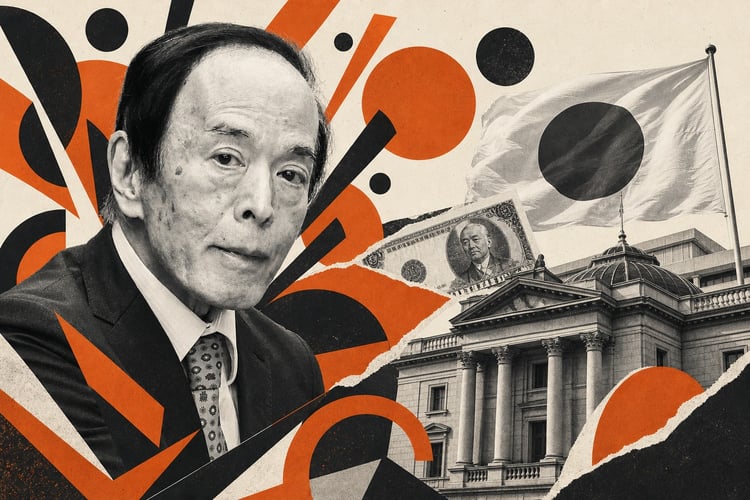
BoJ’s Ueda: Japan's economy recovering moderately albeit with some weaknesses
Bank of Japan (BoJ) Governor Kazuo Ueda said on Tuesday that the Japanese economy is recovering moderately albeit with some weaknesses. Ueda added that price trend is approaching 2%.
Key quotes
Japan's economy recovering moderately albeit with some weaknesses.
September tankan showed business sentiment in good shape.
Underlying inflation approaching 2%.
Economy, prices moving in line with our baseline forecasts.
Financial conditions are accommodative.
Even after September rate hike, accommodative financial conditions continue to support economic activity.
Will continue to raise policy rate in accordance with economic, price, financial developments.
Pace and timing of future policy adjustment will be decided based on likelihood of our baseline projections materialising as well as risks.
Important to anchor underlying inflation around 2%.
Market reaction
At the time of writing, the USD/JPY pair is up 0.18% on the day at 158.20.
Ueda keeps BoJ on gradual tightening path as Yen focus stays on inflation
FXS Speechtracker scores the speech at 7.2, exactly in line with Ueda’s historic average, signaling a consistent policy tone rather than a surprise shift. The emphasis on the economy “recovering moderately,” favorable business sentiment, and accommodative financial conditions, even after the September rate hike, points to a mildly hawkish bias, as BoJ remains committed to further gradual rate increases while avoiding aggressive tightening.
By stressing that underlying inflation is approaching 2% and that economy and prices are moving in line with baseline forecasts, Ueda reinforces confidence that BoJ is on track toward the inflation target, which supports a constructive backdrop for the Yen. The pledge to “continue to raise policy rate” in accordance with economic, price, and financial developments, and the importance of anchoring inflation around 2%, underpins expectations of a slow but ongoing normalization, likely offering medium-term support to the Yen while limiting immediate volatility.
Japanese Yen FAQs
The Japanese Yen (JPY) is one of the world’s most traded currencies. Its value is broadly determined by the performance of the Japanese economy, but more specifically by the Bank of Japan’s policy, the differential between Japanese and US bond yields, or risk sentiment among traders, among other factors.
One of the Bank of Japan’s mandates is currency control, so its moves are key for the Yen. The BoJ has directly intervened in currency markets sometimes, generally to lower the value of the Yen, although it refrains from doing it often due to political concerns of its main trading partners. The BoJ ultra-loose monetary policy between 2013 and 2024 caused the Yen to depreciate against its main currency peers due to an increasing policy divergence between the Bank of Japan and other main central banks. More recently, the gradually unwinding of this ultra-loose policy has given some support to the Yen.
Over the last decade, the BoJ’s stance of sticking to ultra-loose monetary policy has led to a widening policy divergence with other central banks, particularly with the US Federal Reserve. This supported a widening of the differential between the 10-year US and Japanese bonds, which favored the US Dollar against the Japanese Yen. The BoJ decision in 2024 to gradually abandon the ultra-loose policy, coupled with interest-rate cuts in other major central banks, is narrowing this differential.
The Japanese Yen is often seen as a safe-haven investment. This means that in times of market stress, investors are more likely to put their money in the Japanese currency due to its supposed reliability and stability. Turbulent times are likely to strengthen the Yen’s value against other currencies seen as more risky to invest in.
Artículos destacados
1Swiss Franc weakens as US Dollar (USD) gains on escalating geopolitical conflicts2Forex Today: US Dollar clings to bullish stance ahead of mid-tier data releases3Swiss Franc: Range-bound within 0.8245–0.8365 band against US Dollar – UOB4Japanese Yen drifts lower as sustained USD buying offsets intervention fears5Turkish Lira: CPI surprise seen enabling rate cut – Commerzbank6ECB’s Lane: High inflation due to energy shock is driving hawkish ECB sentiment7NZD/USD Price Forecast: Declines below 0.5600 as bearish bias holds despite oversold RSI8Equities: Broad catch-up as yields back up – Danske Bank9AUD/USD Price Forecast: Struggles to return to 0.7000 amid firm US Dollar
COTIZACIONES EN VIVO


¡Comience ahora!
Regístrese y acceda a los mercados globales en menos de 3 minutos

Conéctese con nosotros









Contactos
Teléfono: +61 2 8036 8388
Fax: +61 2 8036 8388
Correo electrónico: support@tmgm.com
Web: https://www.tmgm.com



La información proporcionada en este sitio web es únicamente de carácter general y no constituye asesoramiento financiero personal. Antes de actuar sobre cualquier información de este sitio web, debe considerar la idoneidad de la información en relación con sus objetivos, situación financiera y necesidades. Invertir en CFD y contratos de margen de FX conlleva riesgos significativos y no es adecuado para todos los inversores. Puede perder más que su depósito inicial. Usted no posee ni tiene ningún interés en el activo subyacente. Le recomendamos que busque asesoramiento independiente y se asegure de comprender plenamente los riesgos involucrados antes de operar. Es importante que lea y considere el documento de divulgación antes de adquirir cualquier producto listado en el sitio web. La información y los anuncios ofrecidos en este sitio web no están destinados al uso por parte de ninguna persona en ningún país o jurisdicción donde dicho uso sea contrario a las leyes y regulaciones locales. Los productos y servicios ofrecidos en este sitio web no están destinados a residentes de Estados Unidos, Malasia y Tailandia.
TMGM está autorizado y regulado en varias jurisdicciones.
Trademax Australia Limited, que opera como TMGM, está regulada por la Comisión Australiana de Valores e Inversiones (ASIC), AFSL n.º 436416, y está ubicada en Level 28, One International Tower, 100 Barangaroo Avenue, 2000 Sydney, NSW Australia.
Correo electrónico: support@tmgm.com.au
Trademax Global Limited, que opera como TMGM, está autorizada y regulada por la Comisión de Servicios Financieros de Vanuatu (VFSC), número de registro 40356, y está registrada en 1276, Kumul Highway, Port Vila, Vanuatu, República de Vanuatu.
Correo electrónico: support@tmgm.com
Trademax Global Markets (SE) Limited, que opera como TMGM, está autorizada y regulada por la Autoridad de Servicios Financieros (FSA) de Seychelles, con número de licencia SD224. La empresa está registrada en Office No 13, Providence Estate ABIS Centre, Mahe, Seychelles.
Correo electrónico: support@tmgm.com
Trademax Global Markets (International) Pty Ltd, que opera como TMGM, está autorizada y regulada por la Comisión de Servicios Financieros de Mauricio (FSC) con licencia n.º GB22201012, y está registrada en 33, Edith Cavell Street C/o IQ EQ Fund Services (Mauritius) Ltd Port Louis, 11324 Mauricio.
Correo electrónico: support@tmgm.com
Copyright © TMGM. Todos los derechos reservados